



.png)
What Is an Electricity Facts Label (EFL)? A Complete Guide
How to read the "nutrition label" of your electricity plan.

Published on Jan 30, 2026
Updated on Jan 30, 2026


If you’ve ever shopped for an electricity plan in Texas, you’ve likely encountered a ton of marketing jargon, "free nights" promises, and dangerous bullseye plans that are always too good to be true. It can be confusing to figure out what you will actually pay each month for electricity.
This is where the Electricity Facts Label (EFL) comes in.
Think of the EFL as the "Nutrition Facts" label for your electricity plan. Just as a food label breaks down calories, protein, and sugar, the EFL breaks down the costs and contract terms of your plan. Understanding how to read this document is one of the most important steps in avoiding "bill shock" and finding the cheapest electricity plan for your home.
What Is an Electricity Facts Label (EFL)?
An Electricity Facts Label (EFL) is a standardized document required by the Public Utility Commission of Texas (PUCT) that provides transparent information about an electricity plan. Specifically, details like energy rates, contract length, fees, and more are outlined. Retail Electric Providers (REP) must provide an EFL for every plan they sell.
How to Read an Electricity Facts Label
Before we get into understanding an EFL, how do you find it in the first place? Well, on whichever shopping site you visit, there will usually be a link near each plan labeled “Fact Sheet,” “EFL,” “More Details,” or something similar. Once you open that, you should be able to see the EFL.
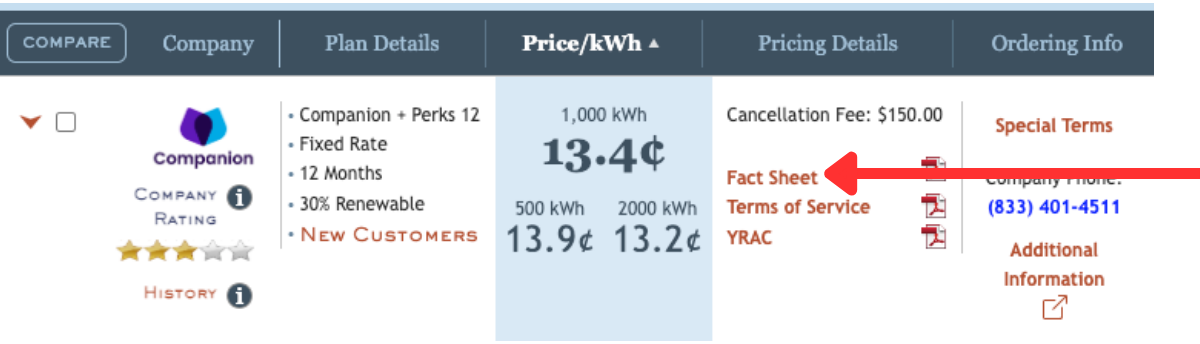
As an example, the following screenshot is from Power to Choose and shows an advertised plan. Next to the red arrow, there is a “Fact Sheet.” That is where the EFL of this plan is located. Once you click that, a PDF will download or a webpage will appear.
The Electricity Price Section
At the very top of the EFL, you will most likely see the electricity provider’s logo and some basic details like the plan’s name and your local Transmission and Distribution Utility (TDU). A TDU (aka TDSP) is a company that owns the equipment that gets your power to you. They maintain the electricity lines and meters. In this specific example, it is the Houston area’s TDU, CenterPoint Energy.

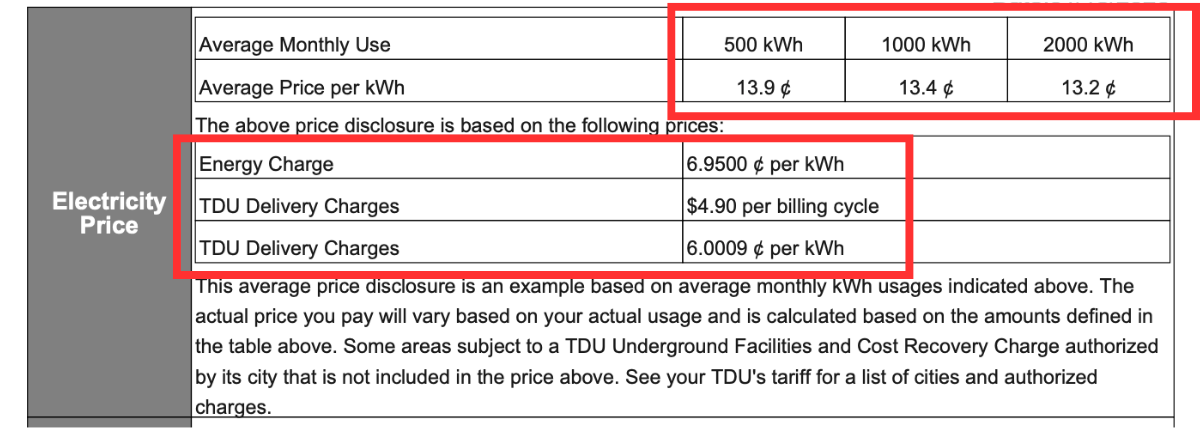
Next, we have the pricing details. This is the most important section. It shows the average price per kilowatt-hour (kWh) based on three example usage levels. But what does that mean? It means if you had this plan and used that amount of kWh for the month, that would be your electricity rate charge per kWh used.
In the screenshot below, we can see that at 500 kWh usage, the effective rate (“all-in” rate) would be 13.9¢. 1,000 kWh would be 13.4¢. And 2,000 kWh would be 13.2¢. The effective rate is the energy charge (6.9500¢ per kWh on this EFL) and all delivery charges ($4.90 base fee + 6.0009¢ per kWh on this EFL) combined.
Remember, delivery charges are unavoidable and you have to pay them in addition to your energy charge on every bill. For more information on delivery charges, check out our blog, Why Do I Have High Electricity Delivery Charges?
Everybody’s electricity usage is different. If you were interested in this plan, here’s an example of how to calculate what your bill would be. Let’s say you used 3,000 kWh (instead of the 500, 1,000, and 2,000 amounts listed on the EFL screenshot above); you would do the following.
Step 1 (Energy charge): 3,000 kWh x $0.0695 = $208.50
Step 2 (TDU charge #1 fixed charge): $4.90
Step 3 (TDU charge #2 variable charge): 3,000 kWh x $0.0600 = $180.03
Step 4 (Total): $208.50 + $4.90 + $180.03 = $393.43
Amount Due: $393.43
If you would like a more detailed step-by-step explanation of this calculation, please click the button below.
Detailed Calculation (Click to View)
To calculate in dollars, we first convert the energy charge listed on the EFL from cents to dollars by moving the decimal point two places to the left.
Energy charge: 6.9500¢ → $0.069500
Next, we multiply the amount of kWh with the energy charge we just converted to dollars.
3,000 kWh x $0.0695 = $208.50
We then have to add in both TDU delivery charges listed on the EFL. TDU delivery charge #1 is already in dollars, so we don’t have to move the decimal point.
TDU delivery charge #1: Flat fee per billing cycle = $4.90
TDU delivery charge #2 is in cents, so we will move the decimal point two spaces to the left to convert it to dollars.
TDU delivery charge #2: 6.0009¢ → $0.060009
Next, we multiply the amount of kWh by TDU delivery charge #2.
3,000 kWh x $0.060009 = $180.027
Now you add all three totals together to get your bill amount.
Total: $208.50 + $4.90 + $180.027 = $393.427
Lastly, you’ll divide the bill amount by the kWh to see what you are paying per kWh after all charges (energy charge & TDU charges) are included.
Effective rate (all-in rate): $393.43 ÷ 3,000 kWh = $0.1311
So, if you used 3,000 kWh on this plan, you would end up paying roughly $0.1311 per kWh. Now to convert that dollar amount back to cents, you would move the decimal point two places to the right. That would give you 13.11¢ per kWh.
Hopefully that wasn’t too hard to understand. If you need help reading or calculating any sort of EFL details, feel free to call or email Energy Ogre at 832-975-1000 or [email protected]. We will have an agent walk you through it step by step. Now back to the scheduled programming.
Other Key Terms and Questions
This section will inform you of important notices for your plan. In this example specifically, it is alerting you that all bills and other correspondence will come through email instead of postal mail.

Disclosure Chart Section
The most important parts of this section tell you:
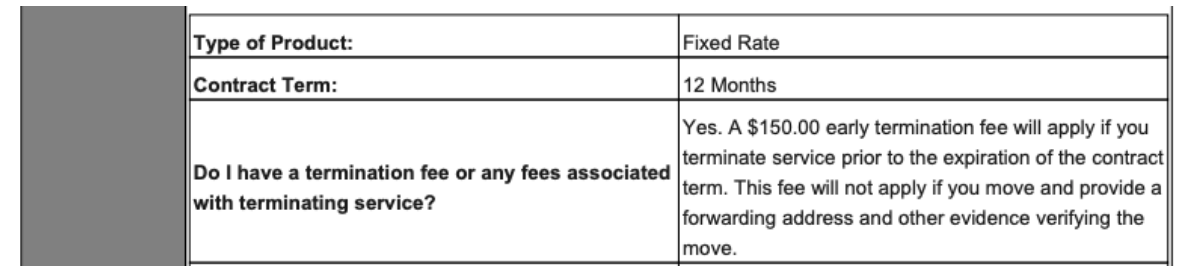
- If you’re on a fixed rate or variable rate
- The length of your contract
- The early termination fee (ETF) if you break a contract and go to a new company
- Note: If you’re moving, you do not have to pay an ETF.
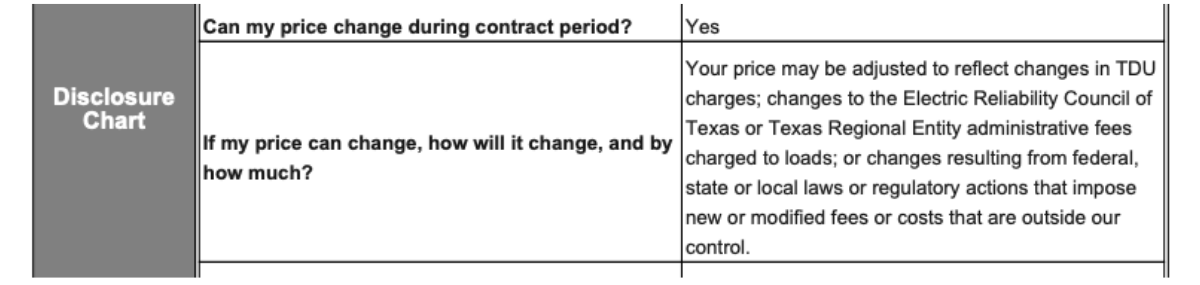
One final detail that tends to throw people off when looking at an EFL is the “Can my price change during the contract period?” section. The answer is, “yes,” but let me explain.
The energy charge is what stays fixed in a fixed-rate plan, but the effective rate (all-in rate) can still fluctuate slightly if TDU rates change.
TDU delivery charges change several times throughout the year. They are controlled by the PUCT.
If you’re in a variable-rate plan, then both the energy charge and the TDU rates can change. That is why fixed-rate plans are always the better option. Some people may argue variable-rate plans may be a good deal some months, but Energy Ogre disagrees. We never enroll our members in these types of plans.
And if you’re curious, you can see a percentage of renewable resources that are used to generate the energy in your plan. Nearly all plans contain some amount of renewable energy. You are only on a full renewable energy (green) plan if the renewable content is listed at 100%.
Note: The renewable content percentage of your plan has no effect on the likelihood of your home experiencing a power outage.

At the very end of the EFL, there may be some contact information for your REP. Now we’re finished!
Need More Help?
If you’re still confused or just don’t want to deal with the hassle of understanding EFLs, consider becoming a member of Energy Ogre. We are an unbiased, independent company that reviews all electricity providers and plans available to find the most cost-effective plan for your home or business. We help prevent Texans from overpaying for electricity.
We’ll Read the Fine Print for You!
Other Articles

Written by:
Garrett Faden is a Content Creator with over 5 years at Energy Ogre. He is dedicated to simplifying the market so Texans can confidently make cost-effective choices.